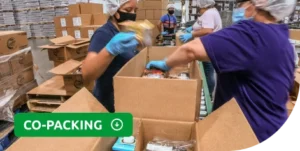
Have you ever wondered how to manage increased demand without costly production expansion? Or how to bring a new product to market quickly without building additional capacity? This is where co-packing comes in — a service that can save you time, money and effort.
As many as 66% of manufacturing companies in the US use external co-packers for at least some of their products. The main reasons include cost savings, faster product launches and a lack of internal capacity.
What is co-packing?
Co-packing, also known as contract packaging, is a form of outsourced packaging in which a company appoints a third party — known as a co-packer — to package its finished products. This model is particularly common in the food, cosmetics and dietary supplement industries, but it is also used in many other sectors.
This means your company can manufacture its products while entrusting their packaging, labelling and finishing to a specialist. The co-packer ensures that the products are ready for sale — quickly, efficiently and in compliance with applicable legislation.
How does co-packing work in practice?
The process usually works as follows:
- The manufacturing company supplies the product.
- The co-packer provides the packaging materials, or the company supplies them.
- The co-packer packages and labels the products in the agreed quantities and prepares them for distribution.
- The finished packages are sent directly to a warehouse or delivered to the customer.
Outsourced co-packing is particularly beneficial when a company lacks packaging space or suitable technology, or needs to respond flexibly to seasonal fluctuations in demand.
Benefits of co-packing for companies
- Cost savings
You do not have to invest in machinery, staff or additional premises. Choosing co-packing can therefore save you thousands or even tens of thousands of euros. - Scalability
You can respond quickly to growing demand or unexpected orders. Have you ever secured a major order but lacked the staff or technical capacity to meet the delivery deadline? - Faster time to market
New products can reach the market without unnecessary delays. This is an ideal solution for seasonal products that need to be launched immediately, as demand may fall once the season ends. - Focus on your core business
Your company can concentrate on product development and manufacturing while leaving packaging to specialists. You can also benefit from the services provided by our sheltered workshop.
When is it worth working with a co-packing company?
- Situation: you need to expand production but do not have enough packaging space.
By moving packaging to an external partner, you gain more room for production itself. - Situation: you lack the necessary technology or staff.
Instead of making costly investments, you can use the expertise and capacity of a co-packing company. - Situation: you need to handle seasonal peaks or rapid growth.
Co-packing is one of the fastest and most cost-effective ways to manage temporary increases in demand without unnecessary stress.
A practical example: A company producing healthy snacks was unable to keep up with demand during the Christmas season. Thanks to a co-packing partnership, it managed to package twice the usual volume without introducing a second shift or building additional warehouse facilities.
An interesting fact to finish
Did you know that co-packers sometimes package products “blind”?
This means they do not know the product in detail — they receive only the technical specifications and the required result. Even so, they can package thousands of units per day without a single error.
If your company is growing, planning new product launches or struggling with limited capacity, co-packing could be the solution that takes your business to the next level — quickly, efficiently and without the need for major investment.
Would you like to learn more about co-packing options in your industry? Contact us — we will be happy to advise you.